
You know the feeling. It’s 6am, a member of staff has called in sick, and you’re staring at a rota that is now one person short. You call around. You check the WhatsApp group. Nobody is available. The shift starts in two hours.
For most care home managers and supported living providers, this is not an unusual morning. Staffing gaps are one of the most persistent operational pressures in adult social care — and yet their true cost is rarely calculated in full.
In this post, we break down what an unfilled shift actually costs your service: in money, in compliance risk, in staff morale, and in the quality of care your residents and service users receive.
The Scale of the Problem
Adult social care in England employs over 1.5 million people — more than the NHS. Yet according to Skills for Care data, the vacancy rate in homecare services stood at just over 10% in March 2025, more than double the rate seen in care homes. Even in care homes, where vacancy rates have improved in recent years, the CQC reports a current vacancy rate of just under 5% — still roughly three times higher than the wider UK job market.
The situation has been made more complex by recent restrictions on overseas recruitment. International care worker recruits fell from around 105,000 in 2023/24 to approximately 50,000 in 2024/25, and the government announced in May 2025 that overseas recruitment for new care workers would end entirely. Providers who had relied on that pipeline are now competing harder for a smaller domestic workforce.
Bottom line: The staffing pool is shrinking at the same time as demand for care is growing. Every unfilled shift matters more than it did five years ago.
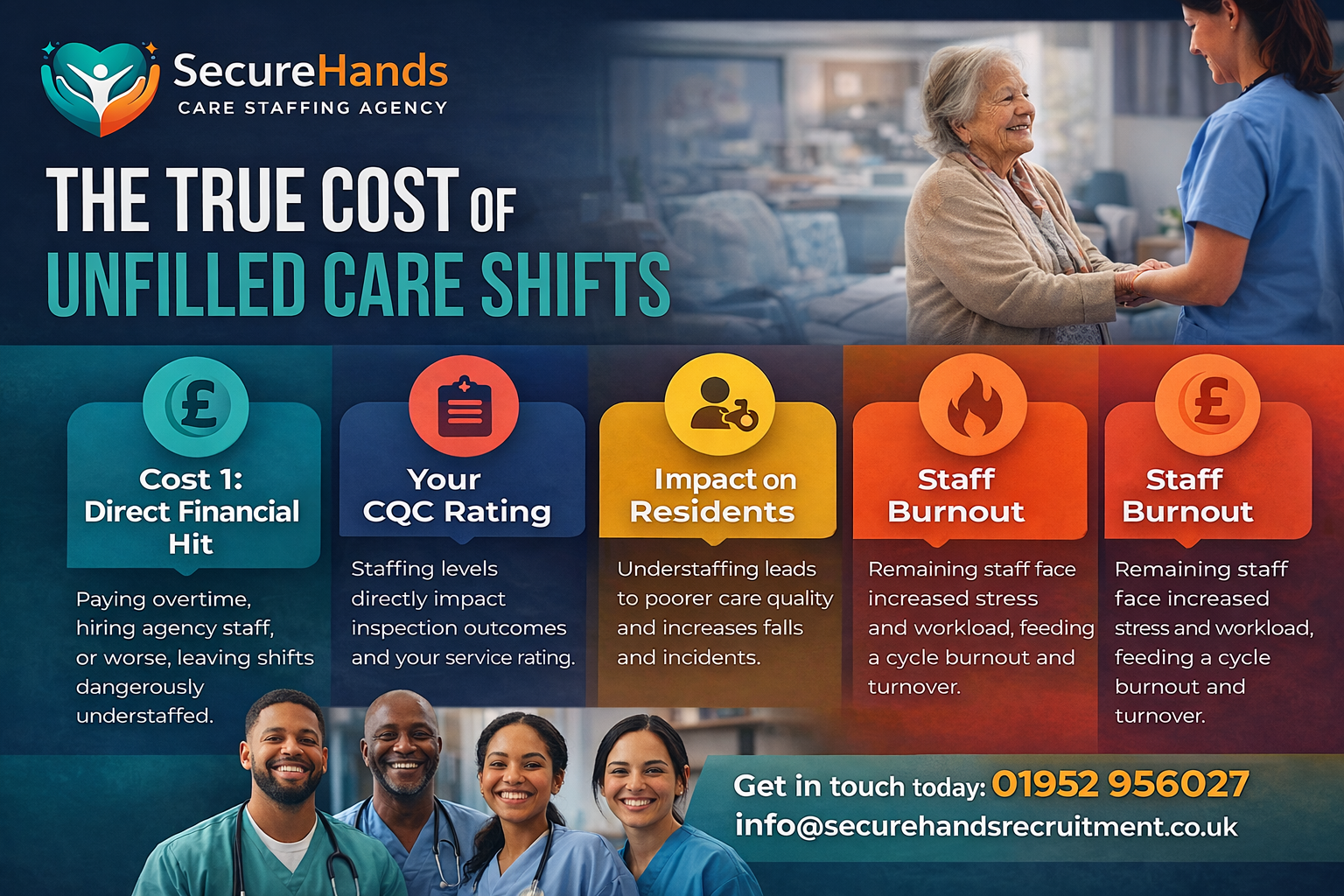
Cost 1: The Direct Financial Hit
The most visible cost of a staffing gap is financial. When a shift cannot be filled by your own team, your options are limited and none of them are free:
- Overtime for existing staff — typically paid at time-and-a-half or double time
- A manager covering the floor — pulling them away from leadership, compliance and admin tasks
- Last-minute agency staff — often at a premium rate above your standard contracted rate
- Leaving the shift dangerously thin — which is not really a cost saving at all
The DHSC workforce survey found that 76.8% of providers identified agency staff being more expensive as their main challenge when filling vacancies. That premium is real — but it needs to be weighed against the alternatives. A shift that runs understaffed does not eliminate cost; it simply moves it elsewhere.
Worth knowing: Labour costs account for between 49% and 57% of the total cost of running a care home. Staffing decisions are your single biggest financial lever.
Cost 2: Your CQC Rating
Staffing levels sit directly within CQC’s Safe domain — one of the five key questions inspectors use to assess your service. If inspectors observe shifts that are understaffed, or if your records show recurring rota gaps, this will be reflected in your inspection outcome.
Research published in peer-reviewed journals is unambiguous on this point: care homes with higher staff vacancy rates are significantly less likely to be rated Good or Outstanding by the CQC. One large national study found that high staff vacancy rates carried a significant negative association with CQC quality ratings — even after controlling for other variables.
The CQC also expects you to have contingency plans in place for staffing shortfalls. Telling an inspector that you could not fill a shift because of recruitment difficulties is not an acceptable answer. In the CQC’s view, good and outstanding services do not simply accept understaffing — they plan proactively to prevent it.
Regulatory reality: A ‘Requires Improvement’ rating does not just reflect poorly on inspection day. It affects your reputation with local authority commissioners, referral partners, and prospective residents’ families.
Cost 3: The Impact on Residents
Behind every staffing gap is a person who needs care. When your team is running short, the effects are tangible and often distressing:
- Less time for personal care, resulting in rushed or delayed support
- Fewer opportunities for meaningful social interaction
- Greater reliance on task-focused care rather than person-centred support
- Increased risk of incidents — falls, medication errors and safeguarding concerns all increase under understaffed conditions
Research funded by the NIHR (National Institute for Health and Care Research) found that care homes rated Good or Outstanding by the CQC were associated with a 12% improvement in residents’ social care-related quality of life compared to homes rated lower — and that staffing was a core driver of that difference.
Families notice. When care quality drops, complaints rise, and reputation takes time to rebuild.
Cost 4: Staff Burnout and the Cycle That Follows
One of the most damaging — and most underestimated — costs of a staffing gap is what it does to the team members who stay.
When colleagues call in sick or leave, the remaining staff absorb the shortfall. Shifts get busier. Breaks get shorter. Over time, this leads to increased stress, higher sickness rates, and ultimately more staff leaving — creating the very gaps that caused the pressure in the first place.
Skills for Care data shows that turnover in adult social care, while improving, still stands at 25% in care homes. That is a quarter of your workforce leaving every year. Each departure costs money in recruitment, induction and lost institutional knowledge — and puts further pressure on those who remain.
The cycle: Staff leave → shifts go unfilled → remaining staff are overstretched → more staff leave. Breaking this cycle requires consistent staffing, not just reactive gap-filling.
Preventing the Gap Before It Happens
The providers who manage staffing most effectively are not the ones who react fastest when a shift falls vacant — they are the ones who rarely find themselves in that position in the first place.
Here is what proactive staffing management looks like in practice:
- Building a relationship with a reliable, compliance-checked agency before you have an urgent need
- Using block bookings to secure consistent cover for known rota patterns
- Planning ahead for holiday periods, winter pressures and known high-risk times
- Treating temp staff as an extension of your team, not a last resort
A good staffing agency should not feel like a panic button. It should feel like part of your workforce strategy.
How SecureHands Can Help
At SecureHands Recruitment Ltd, we supply fully vetted Healthcare Assistants and Support Workers to care homes, supported living services, day care centres and other adult social care settings across Shropshire and the West Midlands.
Every worker we place has:
- An enhanced DBS check
- Verified right-to-work status
- Confirmed care-related training and experience
- Checked and valid references
We offer ad-hoc cover, planned rota support, block bookings and temp-to-perm arrangements — with a 24-hour response commitment on shift requests.
If your service is regularly dealing with last-minute staffing gaps, we would welcome the opportunity to talk through how we can help you build something more stable.
Get in touch: info@securehandsrecruitment.co.uk | 01952 956027
Sources & further reading
Skills for Care — The Size and Structure of the Adult Social Care Sector and Workforce in England 2024/25
CQC — The State of Health Care and Adult Social Care in England 2024/25
DHSC — Adult Social Care Workforce Survey, April 2025
NIHR — MiCareHQ study: Care Home Residents’ Quality of Life and its Association with CQC Ratings and Workforce Issues
Nuffield Trust / Community Care — Adult Social Care Funding Analysis, 2025